
“To be…a chuser of books! And to be having any one’s improvement in view in her choice!” So marvels Jane Austen’s good heroine, Fanny Price, as she rhapsodizes about the opportunities to improve oneself by being a renter…“a chuser [sic] of books” from a circulating library.
Agreed. To read the writings of the world’s great thinkers and to read the great literature of the western world is to understand the genesis and progression of modern philosophy, religions, language, and science; to observe constants in human nature; to learn from those who have preceded us, both of the truths they illustrated and the errors of which they theorized; it is to see the glory of God reflected in his image bearers as they display their God-given abilities of reason and thought as well as language, spiritual understanding and creativity.
A similar enthusiasm to Fanny’s goal of self-improvement and an accompanying desire to continue to learn new things all my life, if the Lord gives me capacity, is reflected in two items on my biblio-dream list (which is several steps removed from a wish list). There are several “classics” collections out there (i.e. Barnes and Noble’s for one) and any number of those titles might be on my wish list, but because of their price, these two collections wait on my dream list—the Harvard Classics and the Yale Shakespeare, 40-volume set.
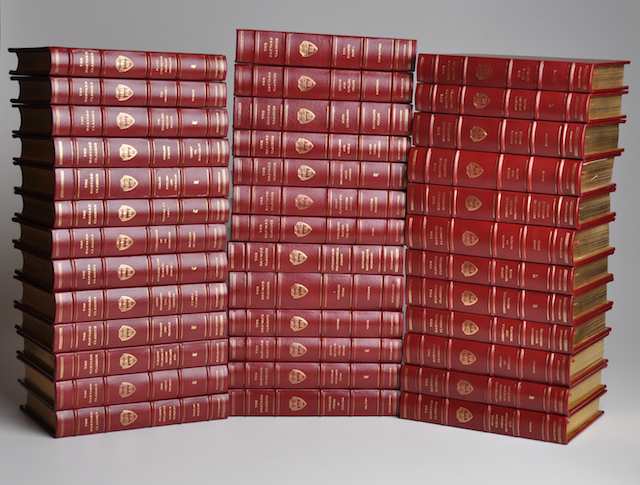
Harvard Classics
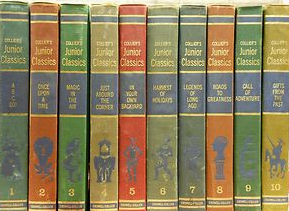 The Harvard Classics collection is a 51-volume set (above) published by P.F. Collier. I suspect Collier modeled his own Collier’s Junior Classics after the Harvard Classics. These beloved Junior Classics (mostly abridged classics) presently stand erect on my bookshelf and bring back good, warm, childhood memories.
The Harvard anthology was originally called Dr. Eliot’s Five Foot Shelf and its authors read like a character list from Lost. According to Wikipedia, Harvard University President, Charles W. Eliot (1869 – 1909), averred that “the elements of a liberal education could be obtained by spending 15 minutes a day reading from a collection of books that could fit on a five-foot shelf (originally he had said a three-foot shelf).”
To be a collector of books is both a blessing and a curse as it is very difficult for a collector to satisfy himself only with the volumes he’s likely to read. Not only must the covers match but the set must be complete. It does not matter if the title is the only thing that will be read of some volumes (i.e. volume 30 for me); the set must have all the volumes in order to be completely worthwhile.
Also, half the fun of collecting books in my opinion is the vision of their faded, but matching covers, beautifully aligned together on one’s bookshelf. For the little less compulsive though, for those whom the bookshelf vision is not a driving force, Bartleby.com provides the Harvard Classics free online and this may be where I myself will have to begin.
What riches do the Harvard Classics contain? Check it out—
- Vol. 1: FRANKLIN, WOOLMAN, PENN
- His Autobiography by Benjamin Franklin
- The Journal of John Woolman by John Woolman (1774 and subsequent editions)
- Fruits of Solitude by William Penn
- Vol. 2. PLATO, EPICTETUS, MARCUS AURELIUS
- The Apology, Phaedo, and Crito by Plato
- The Golden Sayings by Epictetus
- The Meditations by Marcus Aurelius
- Vol. 3. BACON, MILTON’S PROSE, THOS. BROWNE
- Essays, Civil and Moral, and New Atlantis by Francis Bacon
- Areopagitica and Tractate of Education by John Milton
- Religio Medici by Sir Thomas Browne
- Vol. 4. COMPLETE POEMS IN ENGLISH, MILTON
- Complete poems written in English by John Milton
- Vol. 5. ESSAYS AND ENGLISH TRAITS, EMERSON
- Essays and English Traits by Ralph Waldo Emerson
- Vol. 6. POEMS AND SONGS, BURNS
- Poems and songs by Robert Burns
- Vol. 7. CONFESSIONS OF ST. AUGUSTINE, IMITATIONS OF CHRIST
- The Confessions by Saint Augustine
- The Imitation of Christ by Thomas á Kempis
- Vol. 8. NINE GREEK DRAMAS
- Agamemnon, The Libation Bearers, The Furies, and Prometheus Bound by Aeschylus
- Oedipus the King and Antigone by Sophocles
- Hippolytus and The Bacchae by Euripides
- The Frogs by Aristophanes
- Vol. 9. LETTERS AND TREATISES OF CICERO AND PLINY
- On Friendship, On Old Age, and letters by Cicero
- Letters by Pliny the Younger
- Vol. 10. WEALTH OF NATIONS, ADAM SMITH
- The Wealth of Nations by Adam Smith
- Vol. 11. ORIGIN OF SPECIES, DARWIN
- The Origin of Species by Charles Darwin
- Vol. 12. PLUTARCH’S LIVES
- Lives by Plutarch
- Vol. 13. AENEID, VIRGIL
- Aeneid by Virgil
- Vol. 14. DON QUIXOTE, Part 1 only, CERVANTES
- Don Quixote part 1, by Cervantes
- Vol. 15. PILGRIM’S PROGRESS, DONNE & HERBERT, BUNYAN, WALTON
- The Pilgrim’s Progress by John Bunyan
- The Lives of Donne and Herbert by Izaak Walton
- Vol. 16. THE THOUSAND AND ONE NIGHTS
- Stories from the Thousand and One Nights
- Vol. 17. FOLKLORE AND FABLE, AESOP, GRIMM, ANDERSON
- Fables by Aesop
- Children’s and Household Tales by Jacob and Wilhelm Grimm
- Tales, by Hans Christian Andersen
- Vol. 18. MODERN ENGLISH DRAMA
- All for Love by John Dryden
- The School for Scandal by Richard Brinsley Sheridan
- She Stoops to Conquer by Oliver Goldsmith
- The Cenci by Percy Bysshe Shelley
- A Blot in the ‘Scutcheon, by Robert Browning
- Manfred by Lord Byron
- Vol. 19. FAUST, EGMONT, ETC. DOCTOR FAUSTUS, GOETHE, MARLOWE
- Faust, part 1, Egmont, and Hermann and Dorothea by Johann Wolfgang von Goethe
- Dr. Faustus by Christopher Marlowe
- Vol. 20. THE DIVINE COMEDY, DANTE
- The Divine Comedy by Dante Alighieri
- Vol. 21. I PROMESSI SPOSI
- I Promessi Sposi by Alessandro Manzoni
- Vol. 22. THE ODYSSEY, HOMER
- The Odyssey by Homer
- Vol. 23. TWO YEARS BEFORE THE MAST, DANA
- Two Years Before the Mast by Richard Henry Dana, Jr.
- Vol. 24. ON THE SUBLIME, FRENCH REVOLUTION, ETC., BURKE
- On Taste, On the Sublime and Beautiful, Reflections on the French Revolution, and A Letter to a Noble Lord by Edmund Burke
- Vol. 25. AUTOBIOGRAPHY, ETC., ESSAYS AND ADDRESSES, J.S. MILL, T. CARLYLE
- Autobiography and On Liberty by John Stuart Mill
- Characteristics, Inaugural Address at Edinburgh, and Sir Walter Scott, by Thomas Carlyle
- Vol. 26. CONTINENTAL DRAMA
- Life is a Dream by Pedro Calderón de la Barca
- Polyeucte by Pierre Corneille
- Phèdre by Jean Racine
- Tartuffe by Molière
- Minna von Barnhelm by Gotthold Ephraim Lessing
- William Tell by Friedrich von Schiller
- Vol. 27. ENGLISH ESSAYS: SIDNEY TO MACAULAY
- Vol. 28. ESSAYS: ENGLISH AND AMERICAN
- Vol. 29. VOYAGE OF THE BEAGLE, DARWIN
- The Voyage of the Beagle by Charles Darwin
- Vol. 30. FARADAY, HELMHOLTZ, KELVIN, NEWCOMB, ETC
- The Forces of Matter and The Chemical History of a Candle by Michael Faraday
- On the Conservation of Force and Ice and Glaciers by Hermann von Helmholtz
- The Wave Theory of Light and The Tides by Lord Kelvin
- The Extent of the Universe by Simon Newcomb
- Geographical Evolution by Sir Archibald Geikie
- Vol. 31. AUTOBIOGRAPHY, BENVENUTO CELLINI
- The Autobiography of Benvenuto Cellini
- Vol. 32. LITERARY AND PHILOSOPHICAL ESSAYS
- Essays by Michel Eyquem de Montaigne
- Montaigne and What is a Classic? by Charles Augustin Sainte-Beuve
- The Poetry of the Celtic Races by Ernest Renan
- The Education of the Human Race by Gotthold Ephraim Lessing
- Letters upon the Aesthetic Education of Man by Friedrich von Schiller
- Fundamental Principles of the Metaphysic of Morals by Immanuel Kant
- Byron and Goethe by Giuseppe Mazzini
- Vol. 33. VOYAGES AND TRAVELS
- An account of Egypt from The Histories by Herodotus
- Germany by Tacitus
- Sir Francis Drake Revived by Philip Nichols
- Sir Francis Drake’s Famous Voyage Round the World by Francis Pretty
- Drake’s Great Armada by Captain Walter Bigges
- Sir Humphrey Gilbert’s Voyage to Newfoundland by Edward Haies
- The Discovery of Guiana by Sir Walter Raleigh
- Vol. 34. FRENCH AND ENGLISH PHILOSOPHERS, DESCARTES, VOLTAIRE, ROUSSEAU, HOBBES
- Discourse on Method by René Descartes
- Letters on the English by Voltaire
- On the Inequality among Mankind and Profession of Faith of a Savoyard Vicar by Jean Jacques Rousseau
- Of Man, Being the First Part of Leviathan by Thomas Hobbes
- Vol. 35. CHRONICLE AND ROMANCE, FROISSART, MALORY, HOLINSHEAD
- Chronicles by Jean Froissart
- The Holy Grail by Sir Thomas Malory
- A Description of Elizabethan England by William Harrison
- Vol. 36. MACHIAVELLI, MORE, LUTHER
- The Prince by Niccolò Machiavelli
- The Life of Sir Thomas More by William Roper
- Utopia by Sir Thomas More
- The Ninety-Five Theses, To the Christian Nobility of the German Nation, and On the Freedom of a Christian by Martin Luther
- Vol. 37. LOCKE, BERKELEY, HUME
- Some Thoughts Concerning Education by John Locke
- Three Dialogues Between Hylas and Philonous in Opposition to Sceptics and Atheists by George Berkeley
- An Enquiry Concerning Human Understanding by David Hume
- Vol. 38. HARVEY, JENNER, LISTER, PASTEUR
- The Oath of Hippocrates
- Journeys in Diverse Places by Ambroise Paré
- On the Motion of the Heart and Blood in Animals by William Harvey
- The Three Original Publications on Vaccination Against Smallpox by Edward Jenner
- The Contagiousness of Puerperal Fever by Oliver Wendell Holmes
- On the Antiseptic Principle of the Practice of Surgery by Joseph Lister
- Scientific papers by Louis Pasteur
- Scientific papers by Charles Lyell
- Vol. 39. FAMOUS PREFACES
- Vol. 40. ENGLISH POETRY 1: CHAUCER TO GRAY
- Vol. 41. ENGLISH POETRY 2: COLLINS TO FITZGERALD
- Vol. 42. ENGLISH POETRY 3: TENNYSON TO WHITMAN
- Vol. 43. AMERICAN HISTORICAL DOCUMENTS
- Vol. 44. SACRED WRITINGS 1
- Vol. 45. SACRED WRITINGS 2
- Christian II: Corinthians I and II and hymns
- Buddhist: Writings
- Hindu: The Bhagavad-Gita
- Mohammedan: Chapters from the Koran
- Vol. 46. ELIZABETHAN DRAMA 1
- Edward the Second by Christopher Marlowe
- Hamlet, King Lear, Macbeth, and The Tempest by William Shakespeare
- Vol. 47. ELIZABETHAN DRAMA 2
- The Shoemaker’s Holiday by Thomas Dekker
- The Alchemist by Ben Jonson
- Philaster by Beaumont and Fletcher
- The Duchess of Malfi by John Webster
- A New Way to Pay Old Debts by Philip Massinger
- Vol. 48. THOUGHTS AND MINOR WORKS, PASCAL
- Thoughts, letters, and minor works by Blaise Pascal
- Vol. 49. EPIC AND SAGA
- Vol. 50. INTRODUCTION, READER’S GUIDE, INDEXES
- Vol. 51. LECTURES
- The last volume contains sixty lectures introducing and summarizing the covered fields: history, poetry, natural science, philosophy, biography, prose fiction, criticism and the essay, education, political science, drama, travelogues, and religion.
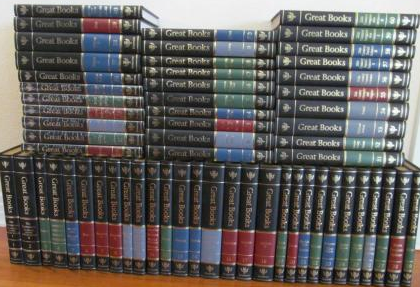 Encyclopædia Britannica seems to have used the Harvard Classics as a springboard for their Great Books of the Western World collection, published in 1952. Wikipedia tells us that University of Chicago president Robert Hutchins and Mortimer Adler collaborated to develop a course, “generally aimed at businessmen, for the purpose of filling in gaps in education, to make one more well-rounded” and familiar with the great ideas of the past three millennia. Hutchins clearly saw the finished work as something much more though, calling the collection an “act of piety.” He said, “Here are the sources of our being. Here is our heritage. This is the West. This is its meaning for mankind.”
Because the Harvard Classics were published in 1909, they necessarily omit most 20th century works. The Great Books were criticized for the same reason. So in 1990, Encyclopædia Britannica published a second edition which added and subtracted from some of the volumes of the previous edition and added 6 more volumes of material covering the 20th century.
There are many overlapping works and authors in the Harvard Classics and The Great Books, but for my money, I am drawn more to the body of titles in the Harvard Classics. Although the second edition of the Great Books offers Alexis de Tocqueville and Calvin’s Institutes, I am not persuaded by the addition of the 20th century material; much of the subject matter covered in these titles is just unalluring to me. Also, since many of these works are still in the realm of modern discourse, it is likely one has already brushed up against the truly great ones in his reading of current events or casual discussions or school assignments. No, my choice would be the Harvard Classics above either edition of the Great Books.
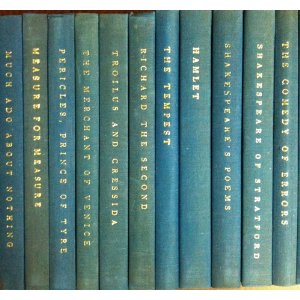
Yale Shakespeare
The 2nd collection on my Dream List is the Yale Shakespeare, 40-volume set. I ran across an incomplete set of these beautiful, perfectly-sized books with their pale blue covers and gilt lettering in a local antique store. I continue to enjoy the idea of a complete set adorning my bookshelf, standing at the ready whenever a comedy or a tragedy might be required.
The 40 volumes of the Yale Shakespeare include:
- Shakespeare of Stratford (which I take to be a biography);
- Shakespeare’s Sonnets;
- “Venus and Adonis, “Lucrece,” and the Minor Poems;
- All’s Well That Ends Well;
- As You Like It;
- The Comedy of Errors;
- King Henry the Fourth (part I);
- King Henry the Fourth (part II);
- King Henry the Sixth (part I);
- King Henry the Sixth (part II);
- King Henry the Sixth (part III);
- The Life of Henry the Fifth;
- The Life and Death of King John;
- The Life of King Henry the Eighth;
- The Life of Timon of Athens;
- Love’s Labour’s Lost;
- Measure for Measure;
- The Merchant of Venice;
- The Merry Wives of Windsor;
- A Midsummer Night’s Dream;
- Much Ado About Nothing;
- Pericles, Prince of Tyre;
- The Taming of the Shrew;
- The Tempest;
- The Tragedy of Antony and Cleopatra;
- The Tragedy of Coriolanus;
- The Tragedy of Cymbeline;
- The Tragedy of Hamlet, Prince of Denmark;
- The Tragedy of Julius Caesar;
- The Tragedy of King Lear;
- The Tragedy of King Richard, the Second;
- The Tragedy of Macbeth;
- The Tragedy of Othello, the Moor of Venice;
- The Tragedy of Richard the Third;
- The Tragedy of Romeo and Juliet;
- The Tragedy of Titus Andronicus;
- The Tragedy of Troilus and Cressida;
- Twelfth Night (or What you Will);
- Two Gentlemen of Verona;
- The Winter’s Tale
In closing, I share the encouragement of C.S. Lewis to seek the great writers in their own words. He wrote, “There is a strange idea abroad that in every subject the ancient books should be read only by the professionals, and that the amateur should content himself with the modern books…The error is rather an amiable one, for it springs from humility. The student is half afraid to meet one of the great philosophers face to face. He feels himself inadequate and thinks he will not understand him. But if he only knew, the great man, just because of his greatness, is much more intelligible than his modern commentator.
“The simplest student will be able to understand, if not all, yet a very great deal of what Plato said; but hardly anyone can understand some modern books on Platonism. It has always therefore been one of my main endeavours as a teacher to persuade the young that firsthand knowledge is not only more worth acquiring than secondhand knowledge, but is usually much easier and more delightful to acquire.”
Lewis continued, “Every age has its own outlook. It is specially good at seeing certain truths and specially liable to make certain mistakes. We all, therefore, need the books that will correct the characteristic mistakes of our own period. And that means the old books.”

 Shooting Over the Horizon
Leave a comment