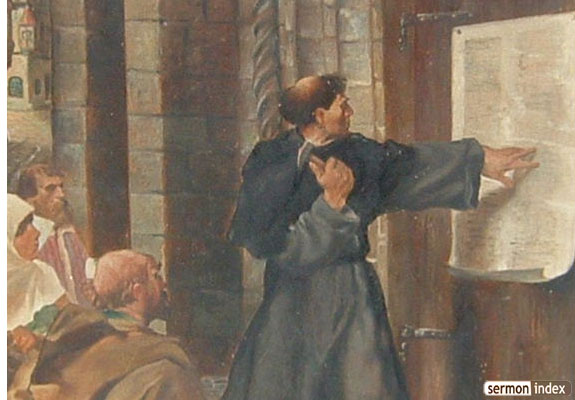
496 years ago today on 10-31-17 (1517, that is), a young monk wrestled with the book of Romans, and got pinned down by Romans 1:17, “The just shall live by faith.” After much anguish and study he carefully outlined 95 discrepancies he noted between the teachings of his church, the Roman Catholic church, and that of the Bible. This young priest, Martin Luther, posted these 95 theses on the community bulletin board of his day, namely, the very publicly visible doors to the chapel in Wittenberg, Germany. His intent was to spark a conversation or debate which might spur the church to return to biblically-sound doctrine.
Instead, he created a firestorm. Among other issues, Luther questioned the church’s practice of selling indulgences, the church’s “Christ + works” teachings, and its adherence to tradition and to the edicts of the Pope as equal in authority to the written Word.
It was demanded of Luther as he stood before the religious council (or Diet as it was known) of Worms (Germany) that he take back what he had written. His famous reply, I cannot and will not recant anything, for to go against conscience is neither right nor safe. Here I stand; I can do no other, so help me God. Amen caused the Roman church to declare Luther a heretic for his religious beliefs and would eventually excommunicate him.
That God raised up Luther for such a time as his becomes even more obvious when one realizes Guttenberg’s printing press was developed about 70 years prior in the 1450’s. After Luther’s bold stand, his writings spread like wildfire as they were easily printed and distributed across Europe where others sounded the clarion call to return to biblical foundations. Thus, the Protestant Reformation was born. These other reformers included men like John Calvin (to whom I’m particularly indebted), John Knox, and Ulrich Zwingli. The Reformation’s influence would someday extend to a band of Englanders who would choose to seperate from their own Church of England, rather than go against conscience. These pilgrims would eventually make their way to the shores of the New World in hopes of establishing their shining city on a hill.
The war cry of the Reformation comes from a compilation of reformed teachings now known as the Five Solae (meaning alone or only):
Sola scriptura (Scripture alone… no added texts or traditions);
Sola fida (faith alone… salvation is through faith, not by works);
Sola gratia (grace alone… it comes to me as favor, as a gift, which I cannot earn);
Sola Christus (Christ alone… Christ is the sole mediator between God and man, denying the office of priest as mediator under the New Covenant);
and lastly,
Soli Deo Gloria (glory to God alone… glory is not to be shared with any substance or creature, not the Pope, not the Virgin Mary, not canonized priests).
On this day of remembrance, I recall my own reformation some 30 years ago which came from the same God and changed my life every bit as dramatically as it did Luther in his priestly cell almost 500 years ago. I am humbly and gratefully reformed… Soli Deo Gloria!
”So if the Son sets you free, you will be free indeed” (John8:36).

 Shooting Over the Horizon
Leave a comment