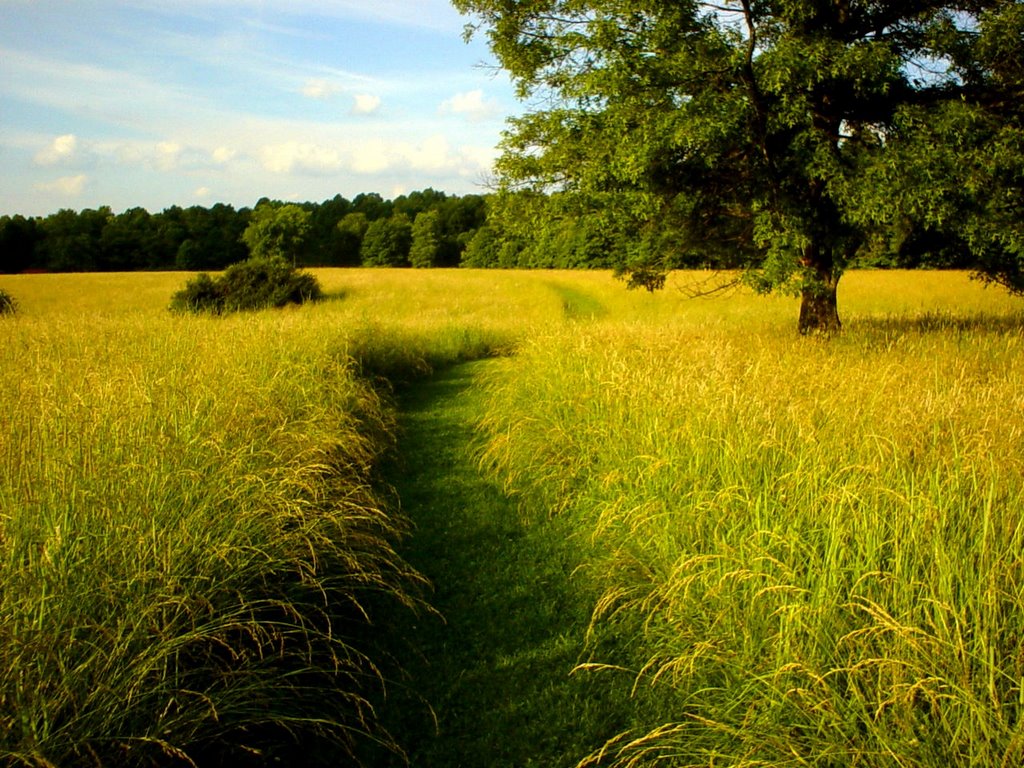
It’s almost unforgivable, I know, but here I stand in the second half of life, only just having completed C.S. Lewis’ The Chronicles of Narnia. And what an ending (or beginning) awaits the reader in The Last Battle, book 7! If you’ll never read the entire seven books, skip to this last one and enjoy! In it, Narnia is one last battle away from its ending and Aslan’s Country is in view.
The Chronicles of Narnia are, of course, a set of seven books that deal with a parallel world to our own, known as Narnia. What’s not to love? – brave and heroic youth; noble, mythological creatures; wrongs to be righted; and a good (but not safe), most high being Who knows the deep magic from before the beginning of time; Who is never late, but rarely early; Who rewards them who diligently seek him; and Who is working out all things for the good of those whom He has called. I speak of the great lion (and Christ figure), Aslan.
In The Last Battle bravery is again called upon and in the face of great cost and danger, Aslan’s true followers must take the adventure Aslan sends, come what may. But Aslan’s country (heaven parallel) is nearer than they know and what a reward awaits those who will endure to the end!
There are so many great themes and quotes in this book – add it to your Bucket List and go ahead and read it! (spoiler alert)
~ ~ ~ ~ ~
I love the noble examples of faith and courage in the face of martyrdom and the commendation for those who will not waver in that hour.
> “Nothing now remains for us seven but to go back to Stable Hill, proclaim the truth, and take the adventure that Aslan sends us.” (ch. IX, “The Great Meeting on Stable Hill,” p. 92)
> “I was going to say I wished we’d never come. But I don’t, I don’t, I don’t. Even if we are killed. I’d rather be killed fighting for Narnia than grow old and stupid at home and perhaps go about in a bath-chair and then die in the end just the same.” (ibid., p. 96)
> ”Courage, Child: we are all between the paws of the true Aslan.” (ch. X, “Who Will Go into the Stable?” p. 107)
> “[Aslan said,] ‘Well done, last of the Kings of Narnia, who stood firm at the darkest hour.’ ” (ch. XIII, “How the Dwarfs Refused to be Taken In,” p. 146)
~ ~ ~ ~ ~
Lewis illustrates two groups and their sorting out in the end – they who seek and savor God in faith and humility of spirit, and those who lean on their own understanding, rejecting the gifts of God that are so near as to be touched and tasted if they would only receive them.
> “I have been wandering to find him and my happiness is so great that it even weakens me like a wound. And this is the marvel of marvels, that he called me Beloved, me who am but as a dog.” (ch. XV, “Further Up and Further In,” pp. 165-166)
> They have chosen cunning instead of belief. Their prison is only in their minds, yet they are in that prison; and so afraid of being taken in that they cannot be taken out.” (ch. XIII, “How the Dwarves Refused to be Taken In,” p. 148)
> The sorting out: “But as they came right up to Aslan one or other of two things happened to each of them. They all looked straight in his face; I don’t think they had any choice about that. And when some looked, the expression of their faces changed terribly – it was fear and hatred… And all the creatures who looked at Aslan in that way swerved to their right, his left, and disappeared into his huge black shadow… The children never saw them again. I don’t know what became of them. But the others looked in the face of Aslan and loved him, though some of them were very frightened at the same time. And all these came in at the Door, in on Aslan’s right.” It is Peter, the High King of Narnia, who shuts the Door after Aslan commands, “Now make an end.” (ch. XIV, “Night Falls on Narnia,” pp. 153-154, 157)
~ ~ ~ ~ ~
But more than all of these, and perhaps precisely because I am in the second half of my life, I found immense joy and hope welling up from Lewis’ descriptions of Aslan’s Country, that promised place beyond the reach of the Shadow-Lands of death; a place we in our world know by another name.
> Here, we realize that Narnia is not the real Narnia. “That had a beginning and an end. It was only a shadow or a copy of the real Narnia, which has always been here and always will be here: just as our own world… is only a shadow or copy of the something in Aslan’s real world… And of course it’s different; as different as a real thing is from a shadow or as waking life is from a dream.” (ch. XV, “Further Up and Further In,” pp. 169-170)
> “It is as hard to explain how this sunlit land was different from the old Narnia… Perhaps you will get some idea of it, if you think like this. You may have been in a room in which there was a window that looked out on a lovely bay of the sea or a green valley that wound away among mountains. And in the wall of that room opposite to the window there may have been a looking glass. And as you turned away from the window you suddenly caught sight of that sea or that valley, all over again, in the looking glass. And the sea in the mirror, or the valley in the mirror, were in one sense just the same as the real ones; yet at the same time they were somehow different – deeper, more wonderful, more like places in a story: in a story you have never heard but very much want to know.” (ibid., p. 170)
> Jewel, the Unicorn, summed up what everyone was thinking: “I have come home at last! This is my real country! I belong here. This is the land I have been looking for all my life, though I never knew it till now. The reason why we loved the old Narnia is that it sometimes looked a little like this.” (ibid., p. 171)
~ ~ ~ ~ ~
Aslan’s Country:
> “…They stood on grass, the deep blue sky was overhead, and the air which blew gently on their faces was that of a day in early summer… There was something in the feel of the air that told him it could not be later than June.” (ch. XIII, “How the Dwarfs Refused to be Taken In,” p. 136)
> “…warm daylight, the blue sky above them, flowers at their feet, and laughter in Aslan’s eyes.” (ch. XIV, “Night Falls on Narnia,” p. 157)
> “Many other creatures were slowly moving the same way, but that grassy country was wide and there was no crowding.” (ch. XV, “Further Up and Further In,” p. 167)
> “I’ve a feeling we’ve got to the country where everything is allowed.” (ch. XIII, “How the Dwarfs Refused to be Taken In,” p. 137)
> “What was the fruit like? Unfortunately, no one can describe a taste. All I can say is that… the freshest grapefruit you’ve ever eaten was dull, and the juiciest orange was dry, and the most melting pear was hard and woody, and the sweetest wild strawberry was sour. And there were no seeds or stones, and no wasps. If you had once eaten that fruit, all the nicest things in this world would taste like medicines after it. But I can’t describe it. You can’t find out what it is like unless you can get to that country and taste for yourself.” (ibid., p. 137)
> “Everyone else began to run, and they found, to their astonishment, that they could keep up with [the Unicorn]… Faster and faster they raced, but no one got hot or tired or out of breath. If one could run without getting tired, I don’t think one would often want to do anything else.” (ch’s XV, “Further Up and Further In” and XVI “Farewell to Shadow-Lands,” pp. 171-172)
> “Isn’t it wonderful?” said Lucy. “Have you noticed one can’t feel afraid, even if one wants to? Try it.”
“By Jove, one can’t,” said Eustace after he had tried. (ch. XVI, “Farewell to Shadow-Lands,” p. 173)
> “About half and hour later – or it might have been half a hundred years later, for time there is not like time here…” (ibid., p. 179)
~ ~ ~ ~ ~
Of those on Aslan’s right:
> “…He led him to the eldest of the Queens – but even she was not old, and there were no grey hairs on her head and no wrinkles on her cheek.” (ch. XII, “Through the Stable Door,” p. 134)
> Edmund describes the railway accident that brought him to Aslan’s Country, saying, “There was a frightful roar and something hit me with a bang, but it didn’t hurt. And I felt not so much scared as – well, excited.” (ch. XIII, “How the Dwarfs Refused to be Taken In,” p. 138)
> “The older Lord Digory describes it as having “been unstiffened… We stopped feeling old.”
“I don’t believe you two really are much older than we are here,” said Jill.
“Well if we aren’t, we have been,” said the Lady Polly. (ibid., p. 138)
> “…Before [Tirian] had had much time to think of this, he felt two strong arms thrown about him and felt a bearded kiss on his cheeks and heard a well-remembered voice…
”It was his own father, the good King Erlian: but not as Tirian had seen him last when they brought him home pale and wounded from his fight with the giant, nor even as Tirian remembered him in his later years when he was a gray-headed warrior. This was his father young and merry as he could just remember him from very early days, when he himself had been a little boy playing games with his father in the castle garden… just before bedtime on summer evenings.” (ch. XVI, “Farewell to Shadow-Lands,” p. 177)
~ ~ ~ ~ ~
Chapter One of the Great Story
> “…They found themselves facing great golden gates. And for a moment none of them was bold enough to try if the gates would open… ‘Dare we? Is it right? Can it be meant for us?’”
”But while they were standing thus a great horn, wonderfully loud and sweet, blew from somewhere inside that walled garden and the gates swung open…
”‘Welcome, in the Lion’s name. Come further up and further in.’ ” (ch. XVI, “Farewell to Shadow-Land,” pp. 176-177)
> “The term is over: the holidays have begun. The dream is ended: this is the morning.
“And as He spoke, He no longer looked to them like a lion; but the things that began to happen after that were so great and beautiful that I cannot write them. And for us this is the end of all the stories, and we can most truly say that they all lived happily ever after. But for them it was only the beginning of the real story. All their life in this world and all their adventures in Narnia had only been the cover and the title page: now at last they were beginning Chapter One of the Great Story which no one on earth has read: which goes on for ever: in which every chapter is better than the one before.” (ibid., pp. 183-184)
Lewis, C. S., and Pauline Baynes. The Last Battle. New York: Collier, 1970. Print.

 Shooting Over the Horizon
Leave a comment